IBU Biathlon (scoring rings) target
Biathlon's paper target, here with optional scoring rings, is for zeroing and training: IBU races are shot on metal or fully electronic targets, and competitors zero on paper at the range in the hour before the start. In a race, standing shots need only hit the black, prone shots a much smaller circle, and every target left standing costs a penalty.
Shot one? Score it from a photo

Courses of fire
5 or 10 shots
| Course | Shots | Maximum |
|---|---|---|
| Prone stage (5)Competition54.5 in decimals | 5 | 50 |
| Standing stage (5)Competition54.5 in decimals | 5 | 50 |
| Zeroing practiceTraining2 × 5 · 109.0 in decimals | 10 | 100 |
How it is shot
Paper targets · Zeroing · Zeroing targets · Target height · Prone and standing · Penalties
- Paper targets
- Paper targets are not permitted in competition, which is shot on metal or fully electronic targets; zeroing is done on paper or fully electronic targets, and training on any of the three.IBU ECR rule 3.4.4.1
- Zeroing
- Before a competition, competitors must get the chance to zero on paper targets at the range for 45 minutes, beginning one hour before and ending no later than 5 minutes before the first start; some competitions have shorter zeroing times.IBU ECR rule 5.3.1
- Zeroing targets
- Zeroing paper targets must stand at the same level and the same distance from the firing lane as the competition targets, with a tolerance of at most +20 cm.IBU ECR rule 5.3.2
- Target height
- The centre of each target is 80 to 100 cm above the surface of the shooting ramp.IBU ECR rule 3.4.4.3
- Prone and standing
- Prone and standing shooters aim at the same black. Standing, all of it is the scoring area; prone, only a 45 mm circle. Paper targets mark the two with dotted lines at 110 mm and 40 mm.IBU Annex A 3.2.1.8
- Penalties
- In competition, every target left standing after all the bout's rounds are fired costs an automatic penalty: 1 minute or 45 seconds of added time, or a 150 m or 75 m penalty loop, depending on the competition.IBU ECR rule 1.4.10.4, Table 1
Dimensions
10 rings · 155 mm
5.6 mm scoring gauge (.22)
| Ring | Colour | Diameter | Centre within |
|---|---|---|---|
| 10 | Black | 8.8 mm0.35 in | 7.2 mm |
| 9 | Black | 26.5 mm1.0 in | 16.05 mm |
| 8 | Black | 44.2 mm1.7 in | 24.9 mm |
| 7 | Black | 61.9 mm2.4 in | 33.75 mm |
| 6 | Black | 79.6 mm3.1 in | 42.6 mm |
| 5 | Black | 97.3 mm3.8 in | 51.45 mm |
| 4 | Black | 115 mm4.5 in | 60.3 mm |
| 3 | White | 128.3 mm5.1 in | 66.95 mm |
| 2 | White | 141.6 mm5.6 in | 73.6 mm |
| 1 | White | 155 mm6.1 in | 80.3 mm |
Source: Annexes to the IBU Event and Competition Rules (Annex A: Material Catalogue), Version 2026 (September 2026), rule Annex A 3.2.1.8 and Table 3A. Sizes are nominal. Dimensions checked ; page updated .
Shooter is not affiliated with or endorsed by the International Biathlon Union (IBU), and its scores are training estimates from a photo, not official results. Spotted an error? Tell us.
Scan offline or with AI
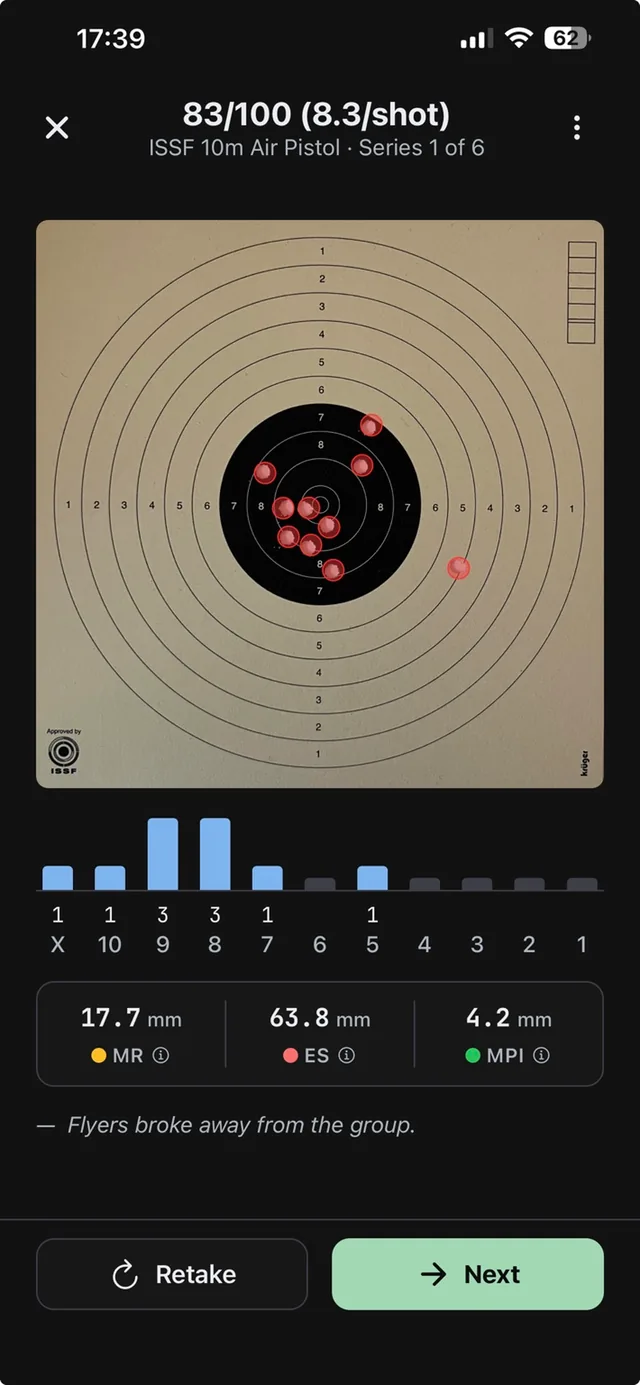
Training on paper? Photograph a card and the Shooter app finds the holes and scores them by these rings: every shot, the series total, your group’s size and centre. Holes merged? Add, move or remove a shot. Every card joins your training log, so drift shows up over time.
Scored with AI for now, which needs internet and your permission to upload the photo to an AI service in the US. Some AI scans may be free while we collect photos of this target; then each uses an AI credit (sold in packs in the app). Scoring by hand is free.