KNSA KKG 12m Rifle target
This is the KNSA's card for national indoor smallbore rifle (Klein Kaliber Geweer): 60 shots prone or kneeling, or 20 in each of three positions, with .22 LR rimfire. Its 10 is a tiny white dot that counts only when the hole covers it completely, and at Dutch and district championships the card is changed after every shot.
Shot one? Score it from a photo

Courses of fire
60 shots
| Course | Shots | Maximum |
|---|---|---|
| Prone 606 × 10 · 654.0 in decimals | 60 | 600 |
| Kneeling 606 × 10 · 654.0 in decimals | 60 | 600 |
| 3 positions 3×203 × 20 · 654.0 in decimals | 60 | 600 |
Badges
Netherlands · KNSA
KNSA-vaardigheidskruis
KNSA proficiency cross
The KNSA set up its proficiency tests for master marksmen, with the cross as their award; its general board changes the requirements, yearly where needed, on the national technical committees’ proposal. The vaardigheidskruis is an enamelled gilt cross on a 27 mm red, white and blue ribbon, and each clasp costs a fee the board sets. The KNSA keeps a numbered register of every test taken, open to any shooter, and sends out the awards itself.
Shot at a KNSA classification match, a district, regional or national championship or an international match, before an authorised KNSA official, and announced before the series with an entry fee; a proef is awarded once a year. The first pass brings the cross, each later one a numbered clasp; 25 passes in all bring a silvered pin, 50 a gilt one. Categories by the age reached in the season, 1 October to 30 September: senioren 21–54, junioren-A 18–20, -B 15–17, -C 13–14, veteranen 55 and over.
KNSA Schiet- en Wedstrijdreglement, deel I (01-10-2026), 20.1, 20.3, 20.5 and 20.6, pp. 30–32
Vaardigheidskruis
KNSAProficiency Cross
Course of fire60 shots at 12 m: prone, kneeling, or 3 × 20
| Proef | Shots | Score |
|---|---|---|
| KK Geweer liggend 12mtr (2.08) | 60 | 560 |
| KK Geweer 3x20 12mtr (2.11) | 60 | 525 |
| KK Geweer knielend 12mtr (2.13) | 60 | 540 |
The score is the match total, on the KNSA 12 m smallbore rifle card; one cross for every category that shoots the proef.
KNSA, Overzicht klasseringseisen seizoen 2026/2027 (14 Sept. 2026), 2.08–2.13; SWR deel III (01-10-2026), 6.2, pp. 6–7; SWR deel I (01-10-2026), H20, pp. 30–32
How it is shot
Prone and kneeling · Three-position · Championships · Card changes · Ammunition · Sights · Gauging
- Prone and kneeling
- Prone and kneeling are 60 shots each: 1 hour 5 minutes on electronic ranges, 1 hour 15 minutes with target transport, sighting included, with four sighting cards per match.KNSA rules 6.4.2, 6.5.1 and 6.5.5
- Three-position
- Three-position is 20 shots each kneeling, prone and standing: 1 hour 45 minutes on electronic ranges, 1 hour 55 minutes with target transport, sighting included; sighting shots are allowed between positions.KNSA rule 6.5.3
- Championships
- Where a championship (NK, DK, AK) has kneeling, prone and three-position, the first 20 shots of the kneeling and of the prone match can count toward three-position, with 20 standing added, shot in consecutive series in that order.KNSA rule 6.5.3
- Card changes
- At Dutch and district championships and Afdeling finals the card is changed after every shot; open matches and Afdeling series may use one or five shots per card. A target changer is not allowed at 12 m.KNSA rules 3.2.9 and 6.1.2
- Ammunition
- Only .22 LR rimfire with an all-lead bullet and only grease as coating is allowed, and no high-velocity ammunition over 360 m/s. Target centres hang 45 cm high for prone, 75 cm kneeling, 140 cm standing (±5 cm).KNSA rules 4.4 and 3.2.11
- Sights
- Veterans may use an optical system in the front-sight tunnel or the diopter (an "Adlerauge"), with shooting glasses, in every Klein Kaliber Geweer discipline.KNSA rule 4.5
- Gauging
- Rings 1 to 9 count the higher value when touched, but the 10, a white dot, counts only when the shot covers it completely; a mouche is a shot lying wholly inside the 8 ring.KNSA rule 3.2.1
Dimensions
10 rings · 40 mm
5.6 mm scoring gauge (.22)
| Ring | Colour | Diameter | Centre within |
|---|---|---|---|
| 10 | Black | 1.4 mm0.06 in | 2.1 mm |
| 9 | Black | 2.7 mm0.11 in | 4.15 mm |
| 8 | Black | 6.8 mm0.27 in | 6.2 mm |
| 7 | Black | 10.9 mm0.43 in | 8.25 mm |
| 6 | Black | 15 mm0.59 in | 10.3 mm |
| 5 | Black | 20 mm0.79 in | 12.8 mm |
| 4 | Black | 25 mm0.98 in | 15.3 mm |
| 3 | White | 30 mm1.2 in | 17.8 mm |
| 2 | White | 35 mm1.4 in | 20.3 mm |
| 1 | White | 40 mm1.6 in | 22.8 mm |
Under the KNSA rules, the 10 ring counts only when the hole covers it completely. A shot counts as a mouche only when the hole lies entirely inside the 8 ring.
Source: KNSA Schiet- en Wedstrijdreglement, deel III Klein Kaliber Geweer, versie 01-10-2026, rule 3.2.1. Sizes are nominal. Dimensions checked ; page updated .
Shooter is not affiliated with or endorsed by Koninklijke Nederlandse Schietsport Associatie (KNSA), and its scores are training estimates from a photo, not official results. Spotted an error? Tell us.
Scan offline or with AI
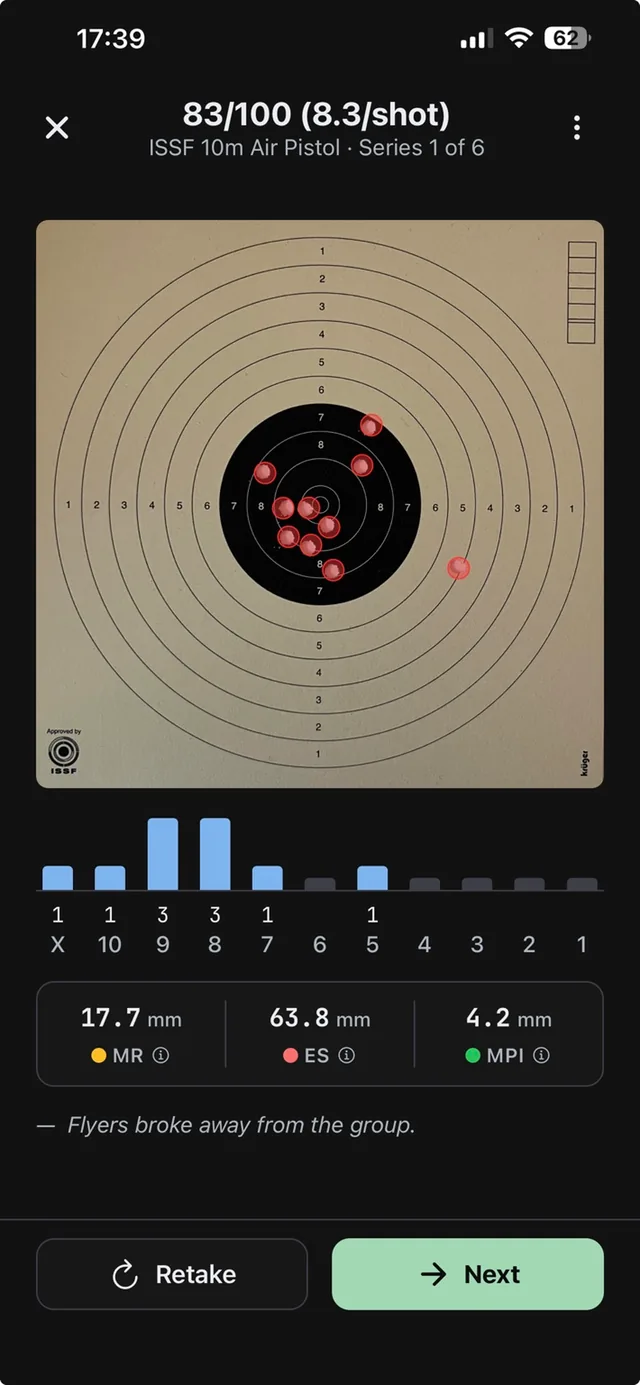
Training on paper? Photograph a card and the Shooter app finds the holes and scores them by these rings: every shot, your inner tens, the series total, your group’s size and centre. Holes merged? Add, move or remove a shot. Every card joins your training log, so drift shows up over time.
Scored with AI for now, which needs internet and your permission to upload the photo to an AI service in the US. Some AI scans may be free while we collect photos of this target; then each uses an AI credit (sold in packs in the app). Scoring by hand is free.