TSNZ 20yd Rifle target
Target Shooting New Zealand's indoor smallbore card for the shorter ranges in some country areas, particularly the South Island, sized so that results compare with the commoner longer ranges. It is shot prone through the indoor season, April to September, ten scoring shots to a card, and gauged outward: a perfect card is 100.10, every shot an inner.
Shot one? Score it from a photo

Courses of fire
10 or 20 shots
| Course | Shots | Maximum |
|---|---|---|
| Indoor 10-shot match12 min | 10 | 100 |
| Indoor 20-shot match2 × 10 · 22 min incl. sighters | 20 | 200 |
| Indoor benchrest 10TSNZ indoor benchrest is shot on its own benchrest card · 12 min | 10 | 100 |
How it is shot
Positions · Time · Sighters · Classes and coaching · Gauging · Misses · Inner ten
- Positions
- Matches are shot prone, the rifle supported only by both hands and one shoulder, with no artificial rest except by dispensation; telescopic and electronic sights are banned.TSNZ IR 6.1, 6.5 and 4.3.6
- Time
- A 10-shot match has 12 minutes and a 20-shot match 22 minutes, sighting shots included; up to one minute of warming shots is allowed before the timing starts.TSNZ IR 11.8.1 and 11.8.2
- Sighters
- Two sighting shots are compulsory and a third is optional; on paper they go on the centre diagram, and in a 20-shot match the two cards hang side by side with one card's sighting diagram defaced.TSNZ IR 11.9.1 and 11.9.2
- Classes and coaching
- A first-year competitor is automatically D grade; after that, grades come from the season's average per ten-shot card (at least six official scores), Master from 97.75. Only C and D grade shooters may be coached, from the rear of the firing point.TSNZ IR 9.1, 9.4 and 11.6.2
- Gauging
- Scoring is outward: apart from inners, the edge of the hole furthest from the centre decides, judged with a TSNZ wide-flange gauge; when the flange touches a scoring line, the lower value counts.TSNZ IR 8.1.2
- Misses
- A hole touching the black, tested with a plug gauge, scores 4; a shot wholly outside the black has no value.TSNZ IR 8.1.2
- Inner ten
- A ten becomes an inner, recorded as 10.1, when the gauge in the hole hides the card's Inner Gauging ring.TSNZ IR 8.1.8
Dimensions
7 rings · 41.1 mm
Card 280 × 192 mm · 5.6 mm scoring gauge (.22)
| Ring | Colour | Diameter | Centre within |
|---|---|---|---|
| 10 | Black | 11.45 mm0.45 in | 2.93 mm |
| 9 | Black | 17.3 mm0.68 in | 5.85 mm |
| 8 | Black | 23.16 mm0.91 in | 8.78 mm |
| 7 | Black | 29.01 mm1.1 in | 11.71 mm |
| 6 | Black | 34.86 mm1.4 in | 14.63 mm |
| 5 | Black | 40.71 mm1.6 in | 23.16 mm |
| 4 | Black | 41.1 mm1.6 in | 23.35 mm |
Under the TSNZ rules, a shot counts as an inner ten only when the hole covers a 1.72 mm circle at the centre completely.
The card
- Card
- The card is light yellow and carries eleven identical black aiming marks.TSNZ Appendix F
Source: TSNZ Indoor Rules of Conduct, 1 January 2026, rule IR 5.1; Appendix F (Indoor Targets Specification – 2012). Sizes are nominal. Dimensions checked ; page updated .
Shooter is not affiliated with or endorsed by Target Shooting New Zealand (TSNZ), and its scores are training estimates from a photo, not official results. Spotted an error? Tell us.
Scan offline or with AI
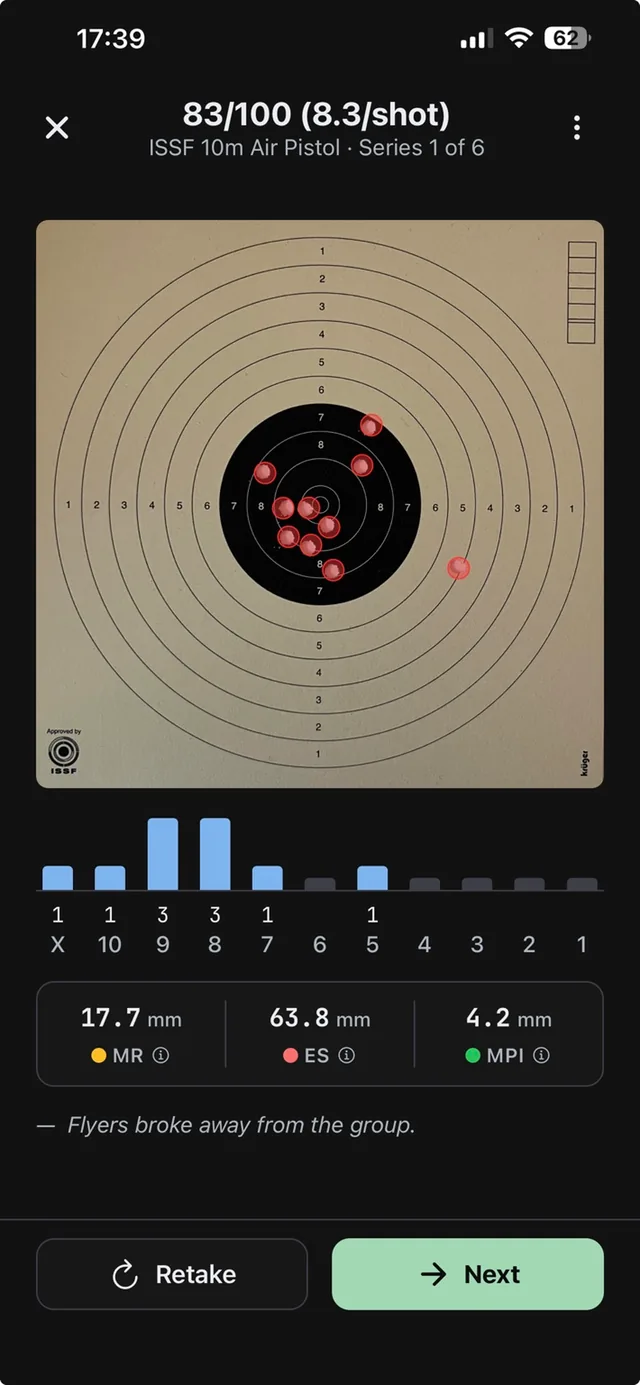
Training on paper? Photograph a card and the Shooter app finds the holes and scores them by these rings: every shot, your inner tens, the series total, your group’s size and centre. Holes merged? Add, move or remove a shot. Every card joins your training log, so drift shows up over time.
Scored with AI for now, which needs internet and your permission to upload the photo to an AI service in the US. Some AI scans may be free while we collect photos of this target; then each uses an AI credit (sold in packs in the app). Scoring by hand is free.