DFS 300m Rifle target
DFS range shooting counts this distance and 200 m as equal at every shoot; both use the same championship programme of 25 shots plus a 10-shot final fired prone in 75 seconds. No telescope is allowed outside the scope and hunter classes, and the NAIS skill badge is shot on this card too.
Shot one? Score it from a photo

Courses of fire
25, 15 or 10 shots
| Course | Shots | Maximum |
|---|---|---|
| Main match5 × 5 · 272.5 in decimals | 25 | 250 |
| 15 shots3 × 5 · 163.5 in decimals | 15 | 150 |
| Final round75 s · 109.0 in decimals | 10 | 100 |
Badges
Norway · DFS and NSF
DFS merker
DFS badges
DFS clubs record their badge shoots in DFS’s online system, and Dugleiksmerket badges are ordered through the regional associations (samlag). Seniors and veterans pay for their own badges, stars, statuette and dish; the diploma is free. Meeting the Dugleiksmerket’s gold requirements 25 times earns a dish and 50 times DFS’s shield, and Skytterboka’s table of gold years runs to 75.
Det frivillige Skyttervesen, Skytterboka 2027, 12.213, 12.216, 12.220 and 12.260–12.270, pp. 148–153
Dugleiksmerket
DFSProficiency Badge
Course of fire25 shots (3 × 5 and 1 × 10), positions by class, from all prone to standing, kneeling and prone; Jegerklassen 15 prone
| Level | All classes25 shots | JegerklassenHunters, 15 shots | HK416 and MP725 shots |
|---|---|---|---|
| Gold | 210 | 130 | 190 |
| Silver | 190 | 115 | 170 |
| Bronze | 170 | 100 | 150 |
- Points in 25 shots, three 5-shot series and a 10-shot series, in positions set by class, from all prone (class 1) to standing, kneeling and prone (classes 3–5); Jegerklassen shoots 15, prone.
- Classes 1–5, V55, Åpen, Kikkert and HK416 shoot at 200 or 300 m, youth, SK, Jeger, V65 and V75 at 100 m; HK416 and MP7 may also use the 15 cm card at 30 m or the Coltskive at 50 m.
- One attempt a year, any level first; youth may try at any meet or club shoot that lists it, and Forsvaret staff more than once, for one badge a year.
- Youth classes win the youth badge, beginners (NU) a bronze each time; gold years add up to medals, stars and a statuette.
Skytterboka 2027, 12.210–12.216, pp. 146–151, and 7.100, p. 58
Skyttermerket
DFSShooter’s Badge
Course of fireNone named in Skytterboka; 250, the top step, is the 25-shot programme’s maximum
| Step | Points |
|---|---|
| 1 | 200 |
| 2 | 210 |
| 3 | 220 |
| 4 | 230 |
| 5 | 240 |
| 6 | 245 |
| 7 | 250 |
- Awarded step by step as a shooter reaches each score.
- Skytterboka names no course, card or period for it; its last step, 250, is the maximum of DFS’s 25-shot programme.
Skytterboka 2027, 12.230, p. 152
350-klubben baneskyting
DFS350 Club, range shooting
Course of fireThe 35-shot championship programme, 25 shots and a 10-shot final, at 100, 200 or 300 m
| Award | Points35 shots |
|---|---|
| MembershipSilver plate and diploma | 350 |
- A perfect score in the class’s 35-shot championship programme, 25 shots and a 10-shot final, at 100, 200 or 300 m; not for classes NU, SK1, SK2, Kikkert, Jeger, Åpen and HK416.
- Club shoots and open or internal listed meets count.
Skytterboka 2027, 12.260, p. 153, and 11.110, p. 116
NAIS-medaljen (NSF)
NAIS medal (NSF)
The NAIS medal was instituted in 1939 as the army-rifle medal of NAIS, the Norwegian branch of the International Shooting Union. Its rules were much simplified in 1990, with slightly higher scores for the better precision rifles, and pistol, clay and running target joined the programme in 1994. NAIS results are not reported to NSF: the organiser records and keeps them on trust.
Shot as a NAIS shoot of its own, run by a Forsvaret unit or a DFS or NSF club; the organiser’s signed result counts. The badges may be won in any order; the medals from the year after the gilt-badge score, the gilt medal after the silver, with one counting result per medal level a year. The recruit badge, for shooters who turn 16 or younger in the year, is won once. Bronze, silver and gilt enamel stars follow the gilt medal, each for its score in three different years, then a statuette.
Norges Sportsskytterforbund, Reglement for NAIS og Kvartmatch (2021, updated 2025), NAIS: Historikk, p. 2; Administrative bestemmelser, p. 6; Norges Sportsskytterforbund, “NAIS-skyting”
NAIS 100/200/300 m rifle
NSF
Course of fire20 shots: 10 prone in 3 min, 10 kneeling in 4 min, after 3 sighters each; at 300, 200 or 100 m
| Level | Class APrecision rifles | Class BHK416, MP7, open sights |
|---|---|---|
| Recruit badgeMay be shot at 100 m | 110 | 110 |
| Bronze badge | 130 | 120 |
| Silver badge | 140 | 130 |
| Gilt badge | 150 | 140 |
| Bronze medal | 160 | 150 |
| Silver medal | 170 | 160 |
| Gilt medal | 185 | 175 |
- Points in 20 shots, 10 prone in 3 minutes and 10 kneeling in 4, with three sighters before each position and no telescopic sight: at 300 m on the 1.5 m card or at 200 m on the 1 m card, and at 100 m on the 100 m card for the recruit badge or with an MP7.
- Class A takes precision rifles approved by DFS and Forsvaret and NSF’s standard rifle; class B the HK416 and MP7 and rifles with open sights.
NSF, Reglement for NAIS (2021, updated 2025), §§ 2–6, pp. 2–5
NSF ferdighetsmerke og Kvartmatch
NSF skill badge and Quarter Match
NSF’s skill badge, in gold, silver and bronze, is awarded in chosen events in every branch, at scores its committee for grassroots sport sets. In NSF’s 10, 25 and 50 m pistol events, the skill badge’s silver score is also the score for promotion to class A. The Kvartmatch rules, adopted by NSF’s board, have been in force since 1991.
Norges Sportsskytterforbund, Fellesreglement (June 2026), Del II, 2.3.2.1–2.3.2.3, p. 18; Norges Sportsskytterforbund, Tabell 5, Merke- og opprykkskrav (2026); Norges Sportsskytterforbund, Reglement for NAIS og Kvartmatch (2021, updated 2025), Kvartmatch, p. 8
Kvartmatch
NSFQuarter Match
Course of fire30 shots, 10 each prone, standing and kneeling, a minute a shot; or the first 10 in each position of a 3 × 20 or 3 × 40
| Level | Class A | Class BHK416, open sights |
|---|---|---|
| Badge | 250 | 190 |
| Bronze medal | 265 | 210 |
| Silver medal | 275 | 235 |
| Gilt medal | 285 | 255 |
Class A: Precision, standard and free rifles
- Points in 30 shots, 10 prone, 10 standing and 10 kneeling, each shot marked, a minute a shot: at 300 m on the 1.5 m card or at 200 m on the 1 m card, or the first ten shots in each position of a 3×20 or 3×40 match.
- Bronze medal before silver, silver before gilt; one counting result per level a year.
- Run by Forsvaret units and NSF and DFS clubs, the protocol signed by the chief marker and the range officer; enamel stars and a statuette follow the gilt medal.
NSF, Reglement for NAIS og Kvartmatch (2021, updated 2025), Kvartmatch §§ 1–6, p. 7
How it is shot
Distance · Course · Positions · Spotting · NAIS badge · Marking · Gauging · Ties
- Distance
- In range shooting, 200 m and 300 m ranges count as equal at every DFS shoot.DFS rule 11.211
- Course
- The championship programme of national, regional and samlag meetings is 25 shots of main match plus a 10-shot final, 35 competition shots and sighters. The first three 5-shot series are called 'klassen', the 10 shots that follow 'grunnlaget'.DFS rule 11.110
- Positions
- Classes 3 to 5 shoot 5 prone in 2 minutes, 5 standing in 3 and 5 kneeling in 2, then 10 shots — 3 standing, 3 kneeling, 4 prone — in 3 minutes; the final is 10 shots prone in 75 seconds. Class 1 shoots everything prone.DFS table 11.110.a
- Spotting
- No kikkert (telescope or binoculars) may be used at any DFS shoot except in the scope and hunter classes, nor a camera to tell the shooter where hits are: paper targets may not be filmed or photographed from the fire command until they are pasted.DFS rule 11.213
- NAIS badge
- The NAIS badge, a skill badge of NSF, DFS and the Armed Forces, is shot on the DFS target at 200 or 300 m: 10 shots prone in 3 minutes and 10 kneeling in 4 minutes, with 3 sighting shots allowed before each series.DFS rules 12.251 and 12.252
- Marking
- In manual marking a miss is shown by swinging the disc back and forth twice before the target, a 9 by moving it up and down over the black, a 10 by circling it clockwise over the centre, an inner ten by blinking it there.DFS rule 9.230.2
- Gauging
- Gauges for .22, 6.5 and 7.62 mm are used to judge values; outdoors at 100 and 200/300 m every gauge, the .22 one too, has an 8 mm flange, and a shot counts inside a dividing line its flange touches.DFS rules 9.230.11 and 9.230.12
- Ties
- Ties go to the most inner tens, then tens, nines and so on over the 25-shot main match; then to the higher score in the last series, then its inner tens, tens and so on; then the series before, and so on.DFS rules 10.401 and 10.402 a
Dimensions
10 rings · 1500 mm
8 mm scoring gauge
| Ring | Colour | Diameter | Centre within |
|---|---|---|---|
| Inner ten | Black | 75 mm3.0 in | 41.5 mm |
| 10 | Black | 150 mm5.9 in | 79 mm |
| 9 | Black | 300 mm11.8 in | 154 mm |
| 8 | Black | 450 mm17.7 in | 229 mm |
| 7 | Black | 600 mm23.6 in | 304 mm |
| 6 | White | 750 mm29.5 in | 379 mm |
| 5 | White | 900 mm35.4 in | 454 mm |
| 4 | White | 1050 mm41.3 in | 529 mm |
| 3 | White | 1200 mm47.2 in | 604 mm |
| 2 | White | 1350 mm53.1 in | 679 mm |
| 1 | White | 1500 mm59.1 in | 754 mm |
Source: Skytterboka, Skytterboka 2027 (gjeldende fra 1.10.2026), rule 9.210. Sizes are nominal. Dimensions checked ; page updated .
Shooter is not affiliated with or endorsed by Det frivillige Skyttervesen (DFS), and its scores are training estimates from a photo, not official results. Spotted an error? Tell us.
Scan offline or with AI
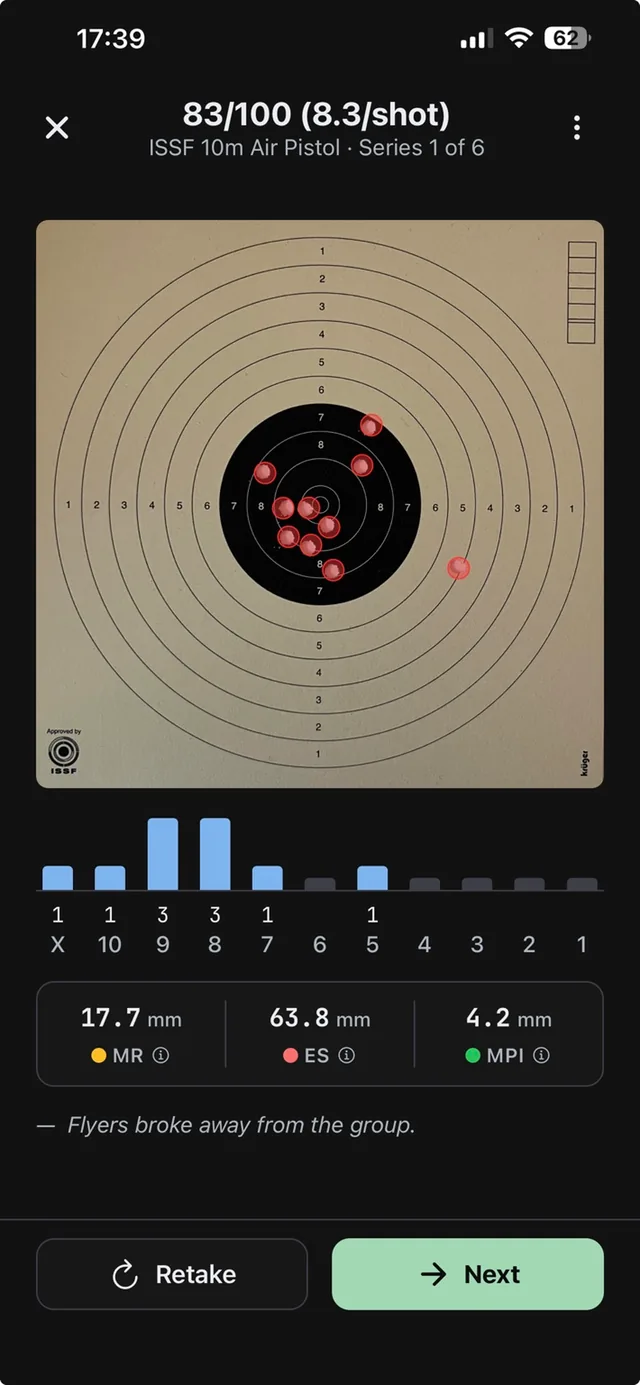
Training on paper? Photograph a card and the Shooter app finds the holes and scores them by these rings: every shot, your inner tens, the series total, your group’s size and centre. Holes merged? Add, move or remove a shot. Every card joins your training log, so drift shows up over time.
Scored with AI for now, which needs internet and your permission to upload the photo to an AI service in the US. Some AI scans may be free while we collect photos of this target; then each uses an AI credit (sold in packs in the app). Scoring by hand is free.