NRA MR-63 300yd Rifle target
The MR-63 shrinks the Mid-Range MR-1 so that the prone slow-fire stage of the National Match Course, normally fired at 600 yd, can be fired at half the distance. It is also the shortest-range card of NRA Mid-Range prone, and F-Class shooters paste the MR-63FC centre over it, adding a smaller X ring.
Shot one? Score it from a photo

Courses of fire
20 or 10 shots
| Course | Shots | Maximum |
|---|---|---|
| Mid-Range22 min | 20 | 200 |
| Short course12 min | 10 | 100 |
Badges
United States · NRA
NRA Marksmanship Qualification Program
The NRA dates the programme to 1903 and measures shooters against par scores in 23 qualifications, from BB gun to shotgun and multi-gun. Awards are ordered from the NRA’s Program Materials Center: the discipline’s patch at the start, then a rocker, medal, pin and certificate for each rating. NRA members who reach Distinguished Expert get its packet free, and those who earn it in 2 or 3 of rifle, pistol and shotgun become Double or Triple Distinguished.
Ratings are earned in order, from Pro-Marksman up, at the shooter’s own pace; a score counts only toward the rating being worked on and cannot be held for a higher one, and the repetitions need not be fired in a row or in one session. Distinguished Expert firing is witnessed by an NRA member, instructor or coach, unless it is shot in competition.
NRA Marksmanship Qualification Program guide book, 11th ed. (January 2021), pp. 1–3 and 53–54; NRA Marksmanship Qualification Program, “Courses of Fire” and “FAQs”
High Power Rifle Qualification
NRA
Course of fire50, 80 or 100 shots: 200 yd standing slow, sitting or kneeling rapid, 60 s; 300 prone rapid, 70 s; 500–600 prone slow
| Rating | Scoreof the possible | Times |
|---|---|---|
| Pro-Marksman | 40% | 2 |
| Marksman | 55% | 2 |
| Sharpshooter | 70% | 3 |
| Expert | 80% | 3 |
| Distinguished Expert | 88% | 10 |
| Distinguished ExpertAt two NRA sanctioned high power competitions | 84% | 2 |
- Percent of the possible score over a 50-, 80- or 100-shot course, any of them at any rating, its four stages fired in one session: standing slow fire at 200 yards, sitting or kneeling rapid fire at 200 (60 seconds), prone rapid fire at 300 (70 seconds), prone slow fire at 500 or 600.
- Times is how many such scores.
- Any U.S. service rifle or centrefire rifle with metallic sights; a sling in every position but standing.
- Cards by range length: 600 yards SR, SR-3 and MR-1; 300 yards SR, SR-3 and MR-63; 200 yards SR, SR-42 and MR-52; 100 yards SR-1, SR-21 and MR-31.
- Open to everyone, NRA members or not; practice, league and match scores all count.
NRA Marksmanship Qualification Program guide book, 11th ed. (January 2021), pp. 26–27
How it is shot
Mid-Range prone · Championships · National Match · Time · Pit marking · Gauging
- Mid-Range prone
- It is also the 300 yd card of Mid-Range prone, in matches of 10 or 20 shots slow fire; the Mid-Range course fires 20 shots each at 300 yd (MR-63), 500 (MR-65) and 600 (MR-1).NRA rules 7.10 and 7.20
- Championships
- In the Mid-Range National Championship, days 1 and 3 each include a 20-shot prone slow-fire match on the MR-63, alongside matches at 500 and 600 yd.NRA rule 7.25
- National Match
- When the National Match Course is fired at 200 and 300 yd, the MR-63 takes its 20-shot prone slow-fire stage, and NRA keeps national records for that version.NRA rule 17.5(r)
- Time
- Slow fire allows one minute per shot, sighters included when specified; in the national-record courses on this card two sighters are fired and recorded in each stage, so a 20-shot stage runs 22 minutes.NRA rules 8.1, 8.2(a) and 17.5
- Pit marking
- Where targets are worked from pits, each slow-fire hit gets a spotter, white in the aiming black and black elsewhere, and the previous hole is pasted over before the target goes back up with the new value signalled.NRA rule 14.17
- Gauging
- Hits are scored on the diameter of the bullet actually fired, with a gauge flange from .224 in (5.56 mm) to .308 in (7.62 mm); electronic targets are set to the shooter’s bullet diameter where possible, otherwise .308.NRA rules 10.17 and 14.3
Dimensions
6 rings · 758.2 mm
7.82 mm scoring gauge
| Ring | Colour | Diameter | Centre within |
|---|---|---|---|
| X ring | Black | 72.39 mm2.9 in | 40.11 mm |
| 10 | Black | 148.59 mm5.9 in | 78.21 mm |
| 9 | Black | 224.79 mm8.8 in | 116.31 mm |
| 8 | Black | 300.99 mm11.9 in | 154.41 mm |
| 7 | Black | 453.39 mm17.9 in | 230.61 mm |
| 6 | White | 605.79 mm23.9 in | 306.81 mm |
| 5 | White | 758.19 mm29.9 in | 383.01 mm |
Source: NRA High Power Rifle Rules, Revised January 2026, rule 4.4(b). Sizes are nominal. Dimensions checked ; page updated .
Shooter is not affiliated with or endorsed by the National Rifle Association of America (NRA), and its scores are training estimates from a photo, not official results. Spotted an error? Tell us.
Scan offline or with AI
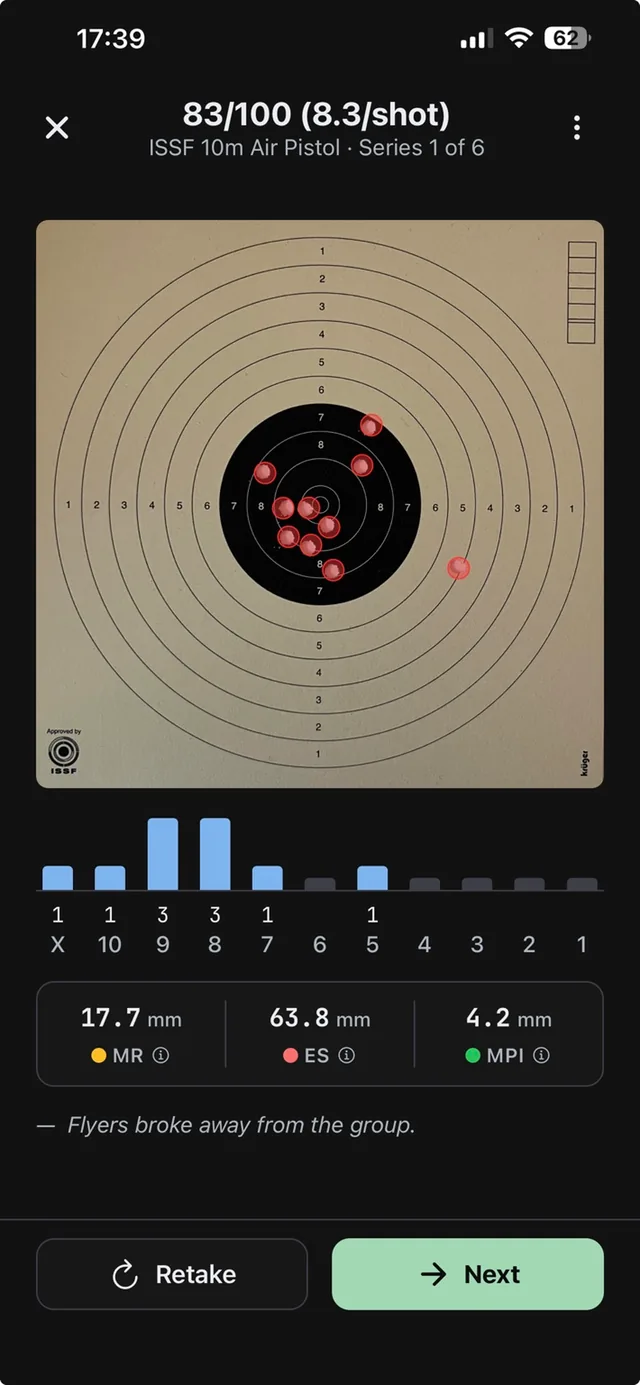
Training on paper? Photograph a card and the Shooter app finds the holes and scores them by these rings: every shot, your X count, the series total, your group’s size and centre. Holes merged? Add, move or remove a shot. Every card joins your training log, so drift shows up over time.
Scored with AI for now, which needs internet and your permission to upload the photo to an AI service in the US. Some AI scans may be free while we collect photos of this target; then each uses an AI credit (sold in packs in the app). Scoring by hand is free.