ISSF 25m Rapid Fire Pistol target
The card for the Olympic Rapid Fire Pistol event and for the rapid-fire stages of Centre Fire Pistol and 25m Pistol. Rapid Fire is shot at five targets, one shot at each, in series of 8, 6 and then 4 seconds; in the finals, a shot is simply a hit or a miss. The same card is also used as the DSB Nr.10 25m RF Pistol (DSB, Germany) and the FFTir 25m RF Pistol (FFTir, France).
Shot one? Score it from a photo

Courses of fire
60 or 30 shots
| Course | Shots | Maximum |
|---|---|---|
| Rapid Fire 6012 × 5 · 8 s / 6 s / 4 s per series | 60 | 600 |
| Sport Pistol duel6 × 5 | 30 | 300 |
| Center Fire duel6 × 5 | 30 | 300 |
Events shot on two targets
| Event | Stages | Shots |
|---|---|---|
| ISSF 25m Sport Pistol | Precision, duel | 60 |
| ISSF 25m Center-fire Pistol | Precision, duel | 60 |
Badges
5 countries
GermanyDSB and KB
Leistungs- und Meisterschützenabzeichen des DSB
DSB proficiency and master marksman badges
The DSB gives its performance badges each year to reward results and to encourage shooting for performance. A badge result can also count as the coordination test of the German Sports Badge (Deutsches Sportabzeichen) the same year. Clubs order the badges on a form at the end of each quarter, through their district, from their state association; in 2026 a small badge cost €4.00, a large one €4.50 and the master marksman badge €6.50.
Age classes go by the age reached in the calendar year, the DSB’s sport year.
DSB, “Leistungsabzeichen”, Ausschreibungen 2026, rules 1, 4, 11 and 13; DSB, “Meisterschützenabzeichen”, Ausschreibungen 2026, rule 5; DSB, “Sportliche Auszeichnungen”
Leistungsabzeichen des DSB
DSBDSB Performance Badge
Course of fireRapid fire pistol, 60 shots; 25 m pistols, 40 or 60 (Jugend 30), half precision on Nr. 4 and half duel
Junioren, Herren and Damen
| Class | Bronze | Silver | Gold |
|---|---|---|---|
| 25m Schnellfeuerpistole (2.30), 60 shots | |||
| Junioren I–II17–20 | 368 | 391 | 414 |
| Herren and Damen I–III21–60 | 418 | 444 | 469 |
| Herren and Damen IV–V61 and over | 392 | 417 | 441 |
| 25m Pistole (2.40), 60 shots | |||
| Junioren I–II17–20 | 430 | 457 | 484 |
| Herren I–III21–60 | 443 | 471 | 498 |
| Damen I–III21–60 | 434 | 461 | 487 |
| Herren and Damen IV–V61 and over | 430 | 457 | 484 |
| 25m Zentralfeuerpistole (2.45): 40 shots as printed, 60 in the Sportordnung | |||
| Junioren I; Herren and Damen I–III19–60 | 429 | 456 | 482 |
| Herren and Damen IV–V61 and over | 422 | 449 | 475 |
| 25m Pistole 9x19, Revolver .357 and .44 Magn., Pistole .45 ACP (2.53, 2.55, 2.58, 2.59), 40 shots | |||
| Junioren I; Herren and Damen I–III19–60 | 302 | 320 | 339 |
| Herren and Damen IV–V61 and over | 288 | 306 | 324 |
Junioren weiblich: the junior numbers less 5 rings, as the footnote says
| Event | Bronze | Silver | Gold |
|---|---|---|---|
| 25m Schnellfeuerpistole (2.30)Junioren I–II weiblich, 17–20 | 363 | 386 | 409 |
| 25m Pistole (2.40)Junioren I–II weiblich, 17–20 | 425 | 452 | 479 |
| 25m Zentralfeuerpistole (2.45)Junioren I weiblich, 19–20 | 424 | 451 | 477 |
| 25m large-bore events (2.53, 2.55, 2.58, 2.59)Junioren I weiblich, 19–20 | 297 | 315 | 334 |
Schüler and Jugend
| Class | Bronze | Silver | Gold |
|---|---|---|---|
| 25m Pistole (2.40), 30 shots | |||
| Jugend15–16 | 190 | 210 | 235 |
Para classes
| Class | Bronze | Silver | Gold |
|---|---|---|---|
| 25m Pistole (2.40), 40 shots | |||
| 92 and 93SH1/AB1 m and w ohne HM: holding free | 314 | 332 | 352 |
- Rings in one match of the shots given, at a club shooting day or any DSB competition, announced to the range officer before the start and shot under supervision; one condition a day, no second try that day.
- The small badge takes the score once; the large badge, after the small one of the same colour, five times within a year.
- Only DSB-approved cards count.
- Female juniors take 5 rings off the junior numbers, as the table’s footnote says (worked out in the Junioren weiblich table); a class with no number may shoot the next stronger class’s.
- The Schnellfeuerpistole is all on this card; 25m Pistole and Zentralfeuerpistole shoot 30 precision shots on Nr. 4 and 30 duel shots here, the large-bore events 20 and 20.
DSB, Tabelle Leistungsabzeichen gesamt (Stand April 2025), pp. 1–2; Leistungsabzeichen rules 1–13, Ausschreibungen 2026 (Stand 30.12.2025)
Meisterschützenabzeichen
DSBMaster Marksman Badge
Course of fireRapid fire pistol, 60 shots; sport, centre-fire and service pistols, 40 or 60
| Event | Shots | Rings |
|---|---|---|
| Jugend, born 2009–2011 | ||
| Schnellfeuerpistole (2.30) | 60 | 470 |
| KK-Sportpistole (2.40) | 40 | 285 |
| Junioren and adults, born 2008 or earlier | ||
| Schnellfeuerpistole (2.30) | 60 | 510 |
| KK-Sportpistole (2.40) | 60 | 530 |
| GK-Zentralfeuerpistole (2.45) | 60 | 530 |
| Gebrauchspistole/-revolver, alle Disziplinen (2.50) | 40 | 365 |
- Totals at championships — Kreis or Gau, Bezirk, Land and German championships, Regional- and Bundesliga matches, European and World Championships, Olympic Games — reached three times within one sport year (Schüler and Jugend: twice), in any mix of events and championships.
- Awarded once a sport year, on the Landesverband’s application.
DSB, Meisterschützenabzeichen, Ausschreibungen 2026 (Stand 21.01.2026), rules 1–6
Schießauszeichnungen des KB
KB shooting awards
The KB’s awards share one design in every weapon type but the English Match, and are told apart by size, colour and inscription. Its Schießsportordnung doubles as the shooter’s record book, in which the club’s shooting officer signs off each award with its score and date. Claims are checked by the district shooting officer and passed on to the state’s; an award won against the rules is withdrawn. The Silbernes Gewehr was first awarded for the 1967 season.
Classes go by the age reached in the calendar year: Schüler up to 14 (Schüler I 10–11, II 12–14); J Sch / Jun, Jungschützen 15–17 and Junioren 18–20, M girls and J boys; Damen and Schützen 21–40; Damen Alt(ers) and Alters 41–50; Damen Sen(ioren) and Senioren 51–60; Sen(ioren) I 61–70 and II 71 and over, with their Damen classes; Behinderte I 18–50, II 51 and over. Klasse I–IV, as the KB defines them for its service arms: I 18–40, II 41–60, III 61–70, IV 71 and over.
Schießsportordnung des Kyffhäuserbundes (28.02.2023), XI 3, 10 and 12, pp. 47–49; Schießbuch, pp. 39 a, 62 a and 69–78 a; Silbernes Gewehr rule 8, p. 82
Schießleistungsnadeln
KBShooting Proficiency Pins
Course of fireOne 15-shot series, or 30 for the 30-shot pin
Kleine Leistungsnadeln (small pins)
| Class | Bronze | Silver | Gold |
|---|---|---|---|
| GK K1-K1A-K2, service pistols and revolvers | |||
| Klasse I | 105 | 110 | 115 |
| Klasse II | 100 | 105 | 110 |
| Klasse III | 95 | 100 | 105 |
| Klasse IV | 90 | 95 | 100 |
Große Leistungsnadeln (large pins)
| Class | Bronze | Silver | Gold |
|---|---|---|---|
| GK K1-K1A-K2, service pistols and revolvers | |||
| Klasse I | 115 | 119 | 123 |
| Klasse II | 110 | 114 | 118 |
| Klasse III | 105 | 109 | 113 |
| Klasse IV | 100 | 104 | 108 |
Große Schießspange and goldene Eichel
| Class | Schießspange | Goldene Eichel |
|---|---|---|
| GK K1-K1A-K2, service pistols and revolvers | ||
| Klasse I | 127 | 125 |
| Klasse II | 123 | 121 |
| Klasse III | 117 | 115 |
| Klasse IV | 112 | 110 |
- Rings in one series of 15 shots (Schüler with LG and LP: 10); a 30-shot pin (Schüler 20) takes twice the number, and the 15-shot pin first.
- Shot at the club on a day the Schießleitung sets, announced beforehand, before the Schießwart and a witness, who sign the numbered cards; one attempt per weapon type a day, and championship results count too.
- In order: bronze, silver, gold; small pins, large pins, Schießspange, Eichel.
- The small pins may all come in one year, on different days; after the small gold, one award per weapon type a year, from the next year (the Senioren classes may take the three large pins in one year).
- Behinderte: their age class, 5 rings less.
Schießsportordnung des KB (Stand 28.02.2023), XI, pp. 47–49, and pp. 62 a–65 a
Leistungsabzeichen in Gold
KBGold Performance Badge
Course of fireChampionship matches: service pistols and revolvers
GK K1-K1A-K2-K2A-ff / 5
| Class | GK K |
|---|---|
| Klasse I | 270 |
| Klasse II | 260 |
| Klasse III | 250 |
| Klasse IV | 240 |
- Championship totals, at the Kreis, Landes and Bundes championships of one sport year: three results reaching these, in the prescribed positions, or their average reaching them; from different weapon types, the summed minimums are set against the summed results.
- Awarded once a year, on the Landesschießwart’s application.
- The numbers are for the closed oak wreath; the half wreath takes 5 rings less in each.
- The table prints “/ 5” after LP Auflage, GK K and FP without saying what it means.
Schießsportordnung des KB (Stand 28.02.2023), pp. 79–80 a
Silbernes Gewehr
KBSilver Rifle
Course of fireEach practice day’s first series of 15 shots, the best 8 days averaged
Hangers: the yearly average
| Class | Bronze | Silver | Gold |
|---|---|---|---|
| GK K1-K1A-K2, service pistols and revolvers: at least 8 days | |||
| Klasse I | 100 | 105 | 110 |
| Klasse II | 90 | 95 | 100 |
| Klasse III | 85 | 90 | 95 |
| Klasse IV | 80 | 85 | 90 |
- A yearly average: the first series of each practice day, 15 shots (Schüler with LG and LP 10, GK L 10, EM 60), competitions included; the worst days are struck down to the minimum printed with the weapon type, and the total is divided by that minimum.
- The base badge comes with the first hanger; then one hanger, bronze, silver or gold, per weapon type and year.
- Open also to Bundeswehr and police members who are not in the KB.
Schießsportordnung des KB (Stand 28.02.2023), pp. 82–84 a
Bundes-Sportschützenabzeichen
KBFederal Sport Shooter Badge
Course of fireEach shooting day’s first series of 30 shots, on at least 5 days
Every series, and the average
| Class | Silver | Gold |
|---|---|---|
| GK K1-K1A-K2, service pistols and revolvers: at least 5 days | ||
| Klasse I | 240 | 250 |
| Klasse II | 230 | 240 |
| Klasse III | 220 | 230 |
| Klasse IV | 210 | 220 |
- Series of 30 shots (Schüler with LG and LP 20, GK L 20, EM 60), the first of each shooting day, every one reaching the number, on at least the days printed with the weapon type; the average over those days decides.
- The text names 10 days for LG and LP and 5 for KK, the table 10 for KK.
- One pin a year, silver first.
- Open also to Bundeswehr and police members who are not in the KB.
- Behinderte: their age class, 5 rings less.
Schießsportordnung des KB (Stand 28.02.2023), pp. 90 a–91 a
Bundes-Lorbeerspange
KBFederal Laurel Clasp
Course of fireEach shooting day’s first series of 30 shots, on at least 8 days
Every series
| Class | Bronze | Silver | Gold |
|---|---|---|---|
| GK K1-K1A-K2, service pistols and revolvers: at least 8 days | |||
| Klasse I | 233 | 243 | 253 |
| Klasse II | 223 | 233 | 243 |
| Klasse III | 213 | 223 | 233 |
| Klasse IV | 203 | 213 | 223 |
- From the year after the gold Bundes-Sportschützenabzeichen: bronze, silver, gold, one a year, in that order.
- Series of 30 shots (Schüler with LG and LP 20, GK L 20, EM 60), the first of each shooting day, every one reaching the number, on at least the days printed with the weapon type; competition results count.
- Open also to Bundeswehr and police members who are not in the KB.
- Behinderte: their age class, 5 rings less.
Schießsportordnung des KB (Stand 28.02.2023), pp. 93 a–94 a
NetherlandsKNSA
KNSA-vaardigheidskruis
KNSA proficiency cross
The KNSA set up its proficiency tests for master marksmen, with the cross as their award; its general board changes the requirements, yearly where needed, on the national technical committees’ proposal. The vaardigheidskruis is an enamelled gilt cross on a 27 mm red, white and blue ribbon, and each clasp costs a fee the board sets. The KNSA keeps a numbered register of every test taken, open to any shooter, and sends out the awards itself.
Shot at a KNSA classification match, a district, regional or national championship or an international match, before an authorised KNSA official, and announced before the series with an entry fee; a proef is awarded once a year. The first pass brings the cross, each later one a numbered clasp; 25 passes in all bring a silvered pin, 50 a gilt one. Categories by the age reached in the season, 1 October to 30 September: senioren 21–54, junioren-A 18–20, -B 15–17, -C 13–14, veteranen 55 and over.
KNSA Schiet- en Wedstrijdreglement, deel I (01-10-2026), 20.1, 20.3, 20.5 and 20.6, pp. 30–32
Vaardigheidskruis
KNSAProficiency Cross
Course of fireRapid fire pistol, 60 shots; sport pistol, 30 precision on the precision card, then 30 duel on this one
| Proef | Shots | Score |
|---|---|---|
| Olympisch Snelvuur Pistool (4.03)Senioren, veteranen, junioren-A | 60 | 504 |
| Sportpistool zwaar kaliber (4.04)Senioren, veteranen | 60 | 535 |
| Sportpistool licht kaliber (4.05)Senioren, veteranen, junioren-A | 60 | 546 |
- The score is the match total.
- Olympisch Snelvuur is shot all on this card; Sportpistool shoots 30 precision shots on the 25 m precision card, then 30 duel shots here.
KNSA, Overzicht klasseringseisen seizoen 2026/2027 (14 Sept. 2026), 4.03–4.05; SWR deel VI (01-10-2026), 6.2, p. 16; SWR deel I (01-10-2026), H20, pp. 30–32
NorwayNSF
NAIS-medaljen (NSF)
NAIS medal (NSF)
The NAIS medal was instituted in 1939 as the army-rifle medal of NAIS, the Norwegian branch of the International Shooting Union. Its rules were much simplified in 1990, with slightly higher scores for the better precision rifles, and pistol, clay and running target joined the programme in 1994. NAIS results are not reported to NSF: the organiser records and keeps them on trust.
Shot as a NAIS shoot of its own, run by a Forsvaret unit or a DFS or NSF club; the organiser’s signed result counts. The badges may be won in any order; the medals from the year after the gilt-badge score, the gilt medal after the silver, with one counting result per medal level a year. The recruit badge, for shooters who turn 16 or younger in the year, is won once. Bronze, silver and gilt enamel stars follow the gilt medal, each for its score in three different years, then a statuette.
Norges Sportsskytterforbund, Reglement for NAIS og Kvartmatch (2021, updated 2025), NAIS: Historikk, p. 2; Administrative bestemmelser, p. 6; Norges Sportsskytterforbund, “NAIS-skyting”
NAIS 25 m pistol
NSF
Course of fire30 shots one-handed, after 5 sighters: 2 × 5 in 150 s, two duel series, one series in 20 s, one in 10 s
| Level | FinUp to .32 | Grov9 mm and up |
|---|---|---|
| Recruit badge | 180 | – |
| Bronze badge | 200 | 180 |
| Silver badge | 210 | 190 |
| Gilt badge | 220 | 200 |
| Bronze medal | 240 | 220 |
| Silver medal | 250 | 230 |
| Gilt medal | 260 | 240 |
- Points in 30 shots on the silhouette (duel) card, one-handed, recruits too: two 5-shot series in 150 seconds, two duel series, one series in 20 seconds and one in 10, after five sighters.
- Fin takes pistols up to .32, grov pistols and revolvers from 9 mm, single-shot pistols in neither; up to two malfunctions are allowed.
NSF, Reglement for NAIS (2021, updated 2025), §§ 2–6, pp. 2–5, and Nasjonale pistolregler 2026, 8.31, p. 6
NSF ferdighetsmerke og Kvartmatch
NSF skill badge and Quarter Match
NSF’s skill badge, in gold, silver and bronze, is awarded in chosen events in every branch, at scores its committee for grassroots sport sets. In NSF’s 10, 25 and 50 m pistol events, the skill badge’s silver score is also the score for promotion to class A. The Kvartmatch rules, adopted by NSF’s board, have been in force since 1991.
Norges Sportsskytterforbund, Fellesreglement (June 2026), Del II, 2.3.2.1–2.3.2.3, p. 18; Norges Sportsskytterforbund, Tabell 5, Merke- og opprykkskrav (2026); Norges Sportsskytterforbund, Reglement for NAIS og Kvartmatch (2021, updated 2025), Kvartmatch, p. 8
Sportsskytterforbundets ferdighetsmerke
NSFNSF Skill Badge
Course of fireEach event’s full course; hurtigpistol 60 shots in series of 10, 8 and 6 s
| Event | Gold | Silver | Bronze |
|---|---|---|---|
| 25 m rapid fire pistol25m Silhuettpistol, 4 | 565 | 550 | 520 |
| 25 m pistol25m Finpistol, 6F | 579 | 570 | 540 |
| 25 m centre-fire pistol25m Grovpistol, 6G | 579 | 570 | 540 |
| 25 m rapid-fire match, small bore25m Hurtigpistol fin, 7F | 583 | 575 | 545 |
| 25 m rapid-fire match, large bore25m Hurtigpistol grov, 7G | 583 | 575 | 545 |
- Hurtigpistol is NSF’s 60-shot match in series of 10, 8 and 6 seconds; finpistol and grovpistol count the whole match, whose precision stage is shot on the precision card.
- Points for the event’s full course at a meet; the meet’s organiser or the shooter’s club issues the requisition, giving the result and the date.
- No order, period or limit on repeats is printed, and the requirements do not apply to classes SH1–SH3.
NSF Tabell 5, Merke- og opprykkskrav (valid from 2026); Fellesreglement (June 2026), 2.3.2, p. 18
SwedenSPSF and SvSF
SPSF förbundsmärken
SPSF federation badges
An SPSF club may back a member’s application for a handgun licence only once the member has met the Pistolskyttemärket’s gold requirements, or, holding gold, those of a year badge (årtalsmärke) in either of the last 2 years. Badges are bought at set prices through SPSF’s member system by 31 January of the year after the test. The Pistolskyttemärket shows crossed wheel-lock pistols from Gustav II Adolf’s armoury, now in the Royal Armoury in Stockholm.
Weapon groups: A service-type large-calibre pistols, B other large-calibre pistols and revolvers, C .22 pistols and revolvers, R large-calibre revolvers.
Svenska Pistolskytteförbundet, Skjuthandbok, 21st edition (2026), Bilaga 1, 1.1 and 5.1.1; Bilaga 8, rule 9; Svenska Pistolskytteförbundet, “Pistolskyttemärken”
Elitmärket
SPSFElite Badge
Course of fire5 × 5 shots precision, 5 min a series, and 5 × 5 shots rapid fire, 3 s a shot
| Level | Points |
|---|---|
| Bronze | 45 |
| Silver | 48 |
| Gold | 49 |
- Points in each of five 5-shot precision series, 5 minutes each, on the precision card, and in each of five 5-shot series on the rapid-fire card at 3 seconds a shot — both, within one calendar year, in training or competition.
- From the year after gold in Pistolskyttemärket; one level a year, each after the one below.
Skjuthandboken 2026 (21st ed.), P 5.4.1, p. 458
Militär Snabbmatchmärket
SPSFMilitary Rapid-Fire Match Badge
Course of fire60 shots: three rounds of 4 × 5 shots, 10, 8 and 6 s a series
| Weapon group | Bronze | Silver | Gold |
|---|---|---|---|
| A | 377 | 454 | 515 |
| B | 391 | 472 | 543 |
| C | 404 | 481 | 550 |
| R | 388 | 467 | 532 |
- Totals for the 60-shot military rapid-fire match — three rounds of four 5-shot series in 10, 8 and 6 seconds — at three different competitions within one calendar year.
- Open to shooters who met the bronze requirements of Pistolskyttemärket the year before; one level a year, each after the one below.
Skjuthandboken 2026 (21st ed.), P 5.10.1, p. 466, and J.6.1, p. 290
SvSF skyttemärken
SvSF shooting badges
SvSF’s rulebook dates its submachine-gun badge to 1946, its smallbore badge to 1971 and its first air-rifle badge to 1973. An SvSF club may back a member’s application for a handgun licence only once the member has met the silver requirements in sport, centre-fire or free pistol within the last 2 years, or SPSF’s gold. For a submachine-gun licence, SvSF asks for 3 years as an active shooter at gold level.
Svenska Skyttesportförbundet, Regelbok Nationellt skytte (2026-03-02), 13.13, pp. 90 and 92; Svenska Skyttesportförbundet, handlingsregler för föreningsintyg för vapenlicens (2025-05-14), rule 10 for handguns, and for rifles
Sport och grovpistol 25 m
SvSFSport and Centre-fire Pistol Badge, 25 m
Course of fire10 × 5 shots precision and 10 × 5 shots rapid fire
| Level | Precisionper 5-shot series | Rapid fireper 5-shot series |
|---|---|---|
| Bronze | 42 | 42 |
| Silver | 45 | 45 |
| Gold | 48 | 48 |
- Points in each of ten 5-shot precision series and in each of ten 5-shot rapid-fire series.
- Members of SvSF clubs only; a level is won when its scores are met and the badge is bought, a higher level the year after the one below at the earliest.
- Gold with one, two or three stars follows for the gold scores met in three more years each.
Skyttemärken SvSF (2023-01-12), pp. 2 and 7
Snabbpistol 25 m
SvSFRapid Fire Pistol Badge, 25 m
Course of fire5 × 30 shots
| Level | Pointsper 30-shot round |
|---|---|
| Bronze | 250 |
| Silver | 265 |
| Gold | 275 |
- Points in each of five 30-shot rounds.
- Members of SvSF clubs only; a level is won when its scores are met and the badge is bought, a higher level the year after the one below at the earliest.
- Gold with one, two or three stars follows for the gold scores met in three more years each.
Skyttemärken SvSF (2023-01-12), pp. 2–3 and 7
SwitzerlandSSV
SSV-Auszeichnungen
SSV awards
The SSV’s Volksschiessen is meant to bring people to sport shooting, and most who shoot it hold no licence: in 2025, 7,868 of the 10,835 shooters in its 50 m edition. Most awards in the 300 m Einzelwettschiessen are Kranzkarten rather than badges, 92 percent of them in 2025. The Sportschützenauszeichnung is there to draw more shooters to club and popular shoots.
Classes go by birth year, as the age reached in the year the season ends. A Kranzkarte (wreath card) is a card worth the francs shown, given as, or instead of, a wreath badge.
SSV, Reglement Schweizer Volksschiessen Gewehr 50m (2016), 1.1; SSV, Jahresbericht 2025 Schweizer Volksschiessen Gewehr 50m, pp. 2 and 20; SSV, Auszeichnungsquoten EWS-G300 2025; SSV, Reglement Sportschützenauszeichnung Gewehr 10m und 50m (2011), 1 and 6
Einzelwettschiessen Pistole 25/50m (EWS-P25/50)
SSVIndividual Shoot, 25 and 50 m pistol
Course of fire15 shots: 3 × 5 in 50, 40 and 30 s, after sighters
P25
| Pistol | E/SElite and seniors, 21–59 | U21/V | U17/SV |
|---|---|---|---|
| RF/CFRimfire or centrefire | 135 | 132 | 129 |
| OPOrdnance pistol | 129 | 126 | 123 |
U21/V: Juniors 17–20, veterans 60–69 · U17/SV: Juniors to 16, senior veterans 70 and over
- Points for 15 shots on the ISSF rapid-fire face, scoring zones 5 to 10: three 5-shot series in 50, 40 and 30 seconds, after sighters.
- Licensed members of an SSV club, once a year, 15 March to 30 September.
- The limit gives a Kranzkarte worth Fr. 10.
- The shoot’s 50 m programme, 10 single shots on the P10 face, has limits of its own; the Feldschiessen and the obligatory programme at 25 m are shot on the rectangular ordnance rapid-fire face, not this one.
AFB EWS-P25/50, Ausgabe 2026 (Reg.-Nr. 4.52.02), §§ 2, 3, 6 and 7, pp. 1–2; Reglement EWS-P25/P50, Ausgabe 2017, Art. 3 and 8–9
Eidgenössische Konkurrenz Pistole 25/50m (EK-P25/50)
SSVFederal Competition, 25 and 50 m pistol
Course of firePrecision 2 × 5 shots, 5 min a series; rapid 2 × 5 shots, 30 s a series
Präzisionsprogramm: 2 × 5 shots, 5 minutes each
| Class | RF/CFRimfire or centrefire | OPOrdnance pistol |
|---|---|---|
| E/SElite and seniors, 21–59 | 90 | 86 |
| U19–U21 / VJuniors 17–20, veterans 60–69 | 88 | 84 |
| U13–U17 / SVJuniors to 16, senior veterans 70 and over | 86 | 82 |
Seriefeuerprogramm: 2 × 5 shots, 30 seconds each
| Class | RF/CFRimfire or centrefire | OPOrdnance pistol |
|---|---|---|
| E/SElite and seniors, 21–59 | 92 | 88 |
| U19–U21 / VJuniors 17–20, veterans 60–69 | 90 | 86 |
| U13–U17 / SVJuniors to 16, senior veterans 70 and over | 88 | 84 |
- Points for the 10 shots of each programme: the precision programme on the ISSF precision face (PP10 / 50 cm), the rapid programme on the ISSF rapid-fire face.
- One limit gives a Kranzkarte worth Fr. 8 or a simple wreath badge; both, a Kranzkarte worth Fr. 10 or the special wreath badge.
- Licensed shooters, under supervision, once a year per distance, 15 March to 30 September.
- The 50 m half, a Standstich on the P10 face and a Feldstich on B10, is awarded the same way with limits of its own.
AFB EK-P25/50, Ausgabe 2026 (Reg.-Nr. 4.51.02), §§ 3–5, pp. 1–2; Reglement EK-P25/50, Ausgabe 2016, §§ 1.4, 2.1, 3 and 4.1
How it is shot
Course · Ready position · Rapid-fire stage · Final · Paper targets · Shots while turning
- Course
- Rapid Fire Pistol is 60 shots in two stages of 30. Each stage has two 5-shot series in 8 seconds, two in 6 and two in 4, one shot at each of five targets, after an optional sighting series in 8 seconds.ISSF rule 8.7.6.3
- Ready position
- Every Rapid Fire series starts from the READY position, the arm pointing down at no more than 45 degrees from the vertical. Seven seconds after ATTENTION, the targets turn to face the athlete, or the green lights come on.ISSF rules 8.7.2 and 8.7.6.3
- Rapid-fire stage
- In the rapid-fire stage of 25m Pistol and 25m Centre Fire Pistol, six 5-shot series, the target appears five times a series for 3 seconds, one shot each time, 7 seconds apart, the arm going back to READY before every shot.ISSF rule 8.7.6.4
- Final
- The best eight start the final from zero, scoring hit or miss. Rapid Fire Pistol Men: eight 5-shot series in 4 seconds, a hit being 9.7 or better. 25m Pistol Women: ten 5-shot rapid-fire series, a hit being 10.2 or better.ISSF rules 6.17.1.1, 6.17.1.5, 6.17.4 and 6.17.5
- Paper targets
- In Rapid Fire Pistol on paper, each of the five targets takes 7 shots a stage, from the sighting series and six match series; they are scored and patched after every series, and replaced for each stage.ISSF rule 8.11
- Shots while turning
- On paper, a shot fired while the target is turning counts as a hit only if its hole, ignoring lead marks, is less than 7.0 mm wide in .22 events or 11.0 mm in Centre Fire Pistol; a skid gauge measures it.ISSF Rules for Paper Target Scoring, rule 5.3.1
Dimensions
6 rings · 500 mm
Card 550 × 520 mm or larger · 5.6 mm scoring gauge (.22)
| Ring | Colour | Diameter | Centre within |
|---|---|---|---|
| Inner ten | Black | 50 mm2.0 in | 27.8 mm |
| 10 | Black | 100 mm3.9 in | 52.8 mm |
| 9 | Black | 180 mm7.1 in | 92.8 mm |
| 8 | Black | 260 mm10.2 in | 132.8 mm |
| 7 | Black | 340 mm13.4 in | 172.8 mm |
| 6 | Black | 420 mm16.5 in | 212.8 mm |
| 5 | Black | 500 mm19.7 in | 252.8 mm |
Source: ISSF Rule Book, Edition 2025 (Second Print 07/2026), effective 1 July 2026, rule 6.3.4.4. Sizes are nominal. Dimensions checked ; page updated .
Shooter is not affiliated with or endorsed by the International Shooting Sport Federation (ISSF), and its scores are training estimates from a photo, not official results. Spotted an error? Tell us.
Scan offline or with AI
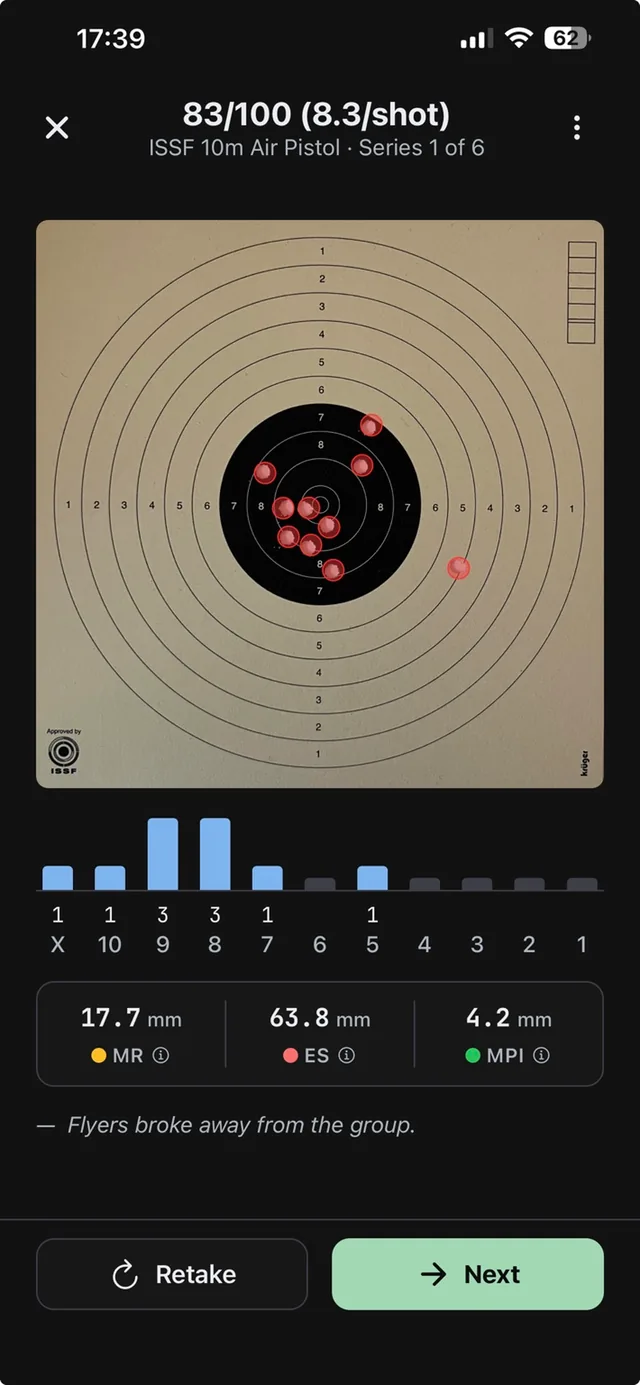
Training on paper? Photograph a card and the Shooter app finds the holes and scores them by these rings: every shot, your inner tens, the series total, your group’s size and centre. Holes merged? Add, move or remove a shot. Every card joins your training log, so drift shows up over time.
Scored with AI for now, which needs internet and your permission to upload the photo to an AI service in the US. Some AI scans may be free while we collect photos of this target; then each uses an AI credit (sold in packs in the app). Scoring by hand is free.