BDS Nr.9 25m Pistol target
The BDS's own pistol card, for the precision part of its classic pistol event: 20 shots standing in two 10-shot series of 5 minutes, in thirteen pistol and revolver classes split by calibre. The same card serves the multi-distance event, shot from 5 to 20 m, partly with the weak hand and against a timer.
Shot one? Score it from a photo

Courses of fire
20 shots
| Course | Shots | Maximum |
|---|---|---|
| Handgun precision2 × 10 · 5 min per series · 218.0 in decimals | 20 | 200 |
How it is shot
Precision · Combined · Classes · Multi-distance · Malfunctions · Gauging and ties
- Precision
- The 25 m precision event is 20 shots, standing, in two 10-shot series of 5 minutes, with up to 10 rounds loaded per series, after any number of sighting shots on this card within 3 minutes.BDS rules K 3.03 to K 3.05 and K 2.10
- Combined
- In the 40-shot Kombi, the 20 precision shots are followed, on the separate interval card, by 10 interval shots (target shown 5 × 3 seconds per series) and 5-shot series in 20 and 10 seconds. Kombi shooters may also be ranked in precision.BDS rules K 3.03, K 3.04 and K 3.09
- Classes
- Thirteen classes split pistols, magnum pistols, revolvers and magnum revolvers by calibre, plus free and service-pistol classes, most with a minimum impulse and a weight limit; the gun is held in one hand or both where the discipline allows.BDS rules K 3.01 and K 2.10
- Multi-distance
- The multi-distance event uses only this card: four 5-shot series of 10 seconds at 5, 10, 15 and 20 m (weak hand, strong hand, then two hands), then a timed course of four series from 20 m in to 5 m on four cards.BDS rules K 4.03 to K 4.07
- Malfunctions
- Gun and ammunition malfunctions are always at the shooter’s own risk: shots lost to them may not be made up, though a second, equivalent gun may be used if the range officer allows; a third reported malfunction in a discipline disqualifies the shooter from it.BDS rules A 9.07 and A 9.08
- Gauging and ties
- A hit takes the higher ring when it visibly touches the dividing line; in doubt, approved overlays with printed calibre diameters may be used. Ties go to the most 10s, then the most inner tens, then the most 9s, 8s, 7s and so on.BDS rules A 9.02 and A 9.03
Dimensions
10 rings · 500 mm
Card 550 × 550 mm · 5.6 mm scoring gauge (.22)
| Ring | Colour | Diameter | Centre within |
|---|---|---|---|
| Inner ten | White | 25 mm0.98 in | 15.3 mm |
| 10 | White | 50 mm2.0 in | 27.8 mm |
| 9 | White | 100 mm3.9 in | 52.8 mm |
| 8 | Black | 150 mm5.9 in | 77.8 mm |
| 7 | Black | 200 mm7.9 in | 102.8 mm |
| 6 | White | 250 mm9.8 in | 127.8 mm |
| 5 | White | 300 mm11.8 in | 152.8 mm |
| 4 | White | 350 mm13.8 in | 177.8 mm |
| 3 | White | 400 mm15.7 in | 202.8 mm |
| 2 | White | 450 mm17.7 in | 227.8 mm |
| 1 | White | 500 mm19.7 in | 252.8 mm |
The card
- Inserts
- Insert centres (Einsteckspiegel) are always allowed in the 25 m events; hits outside the insert are recorded with their value on it.BDS rule K 3.08
Source: BDS Sporthandbuch, Teil Z – Zielscheiben, Fassung des BVA-Genehmigungsbescheids vom 27.06.2025; Red. 30.06.2025, rule Z9 BDS-Kurzwaffenscheibe. Sizes are nominal. Dimensions checked ; page updated .
Shooter is not affiliated with or endorsed by Bund Deutscher Sportschützen (BDS), and its scores are training estimates from a photo, not official results. Spotted an error? Tell us.
Scan offline or with AI
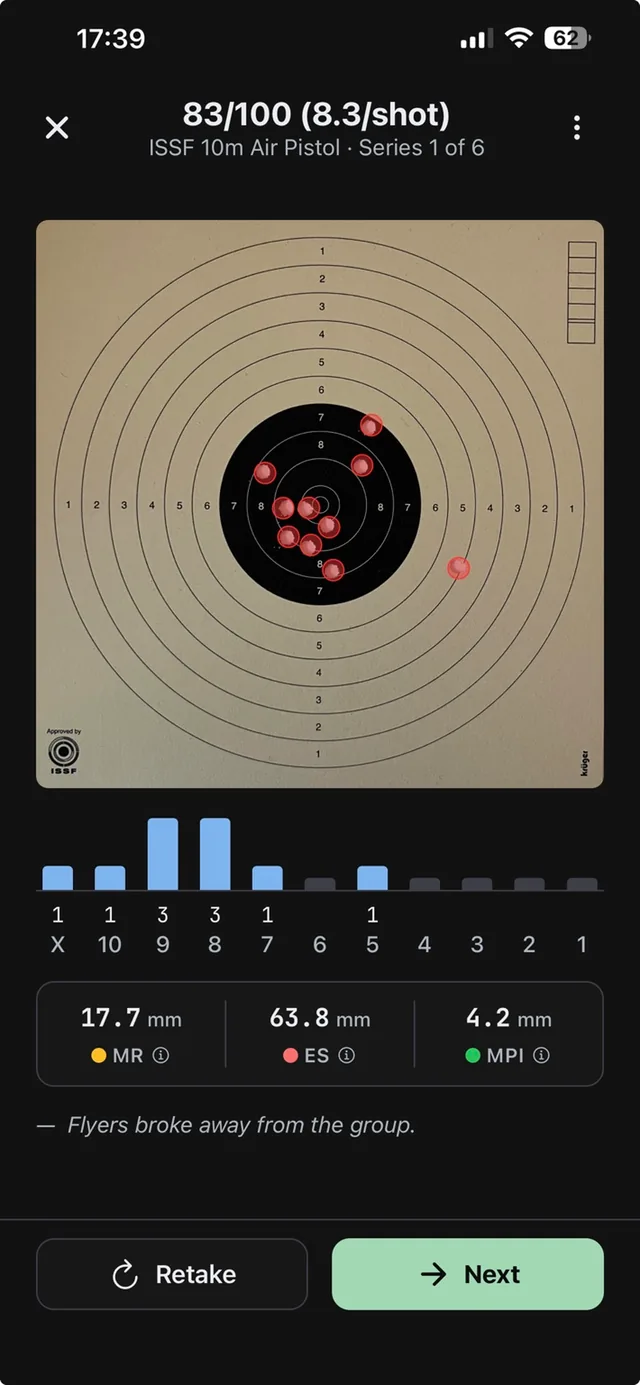
Training on paper? Photograph a card and the Shooter app finds the holes and scores them by these rings: every shot, your inner tens, the series total, your group’s size and centre. Holes merged? Add, move or remove a shot. Every card joins your training log, so drift shows up over time.
Scored with AI for now, which needs internet and your permission to upload the photo to an AI service in the US. Some AI scans may be free while we collect photos of this target; then each uses an AI credit (sold in packs in the app). Scoring by hand is free.